How Automation is Shaping the Future of Electromagnetic Engineering
At Electro Magnetic Applications, Inc. (EMA), automation is viewed as the future of electromagnetic simulation, making it easier to tackle complex challenges faster and with more confidence.
“Automations help drive real solutions on industrial problems,” EMA Co-CEO Tim McDonald said.
Automation is how EMA turns advanced electromagnetic and plasma simulation into practical engineering value by removing manual effort, reducing setup time, and enabling faster, repeatable design decisions. Examples include automating PCB import, source creating from RE102 measurements, and x-ray coupling analysis.
The benefits of EMA automation services are clear:
- Earlier identification of design problems in the engineering process
- Automated, repeatable workflows that scale across projects
- Improved design outcomes driven by faster, more frequent simulation
Keeping Pace with Modern Engineering
Today’s engineering teams face pressure to move faster. When simulations take too long to set up or run, they stop being decision-making tools and become bottlenecks. Late-stage electromagnetic compatibility (EMC) issues can lead to costly rework and delays.
Automation keeps pace with modern development workflows by significantly reducing the time required to prepare simulations while increasing impact on designs. It does not just deliver faster results, but continuous improvement by making simulation repeatable, scalable, and practical for day-to-day engineering use.
Building Scalable Automation
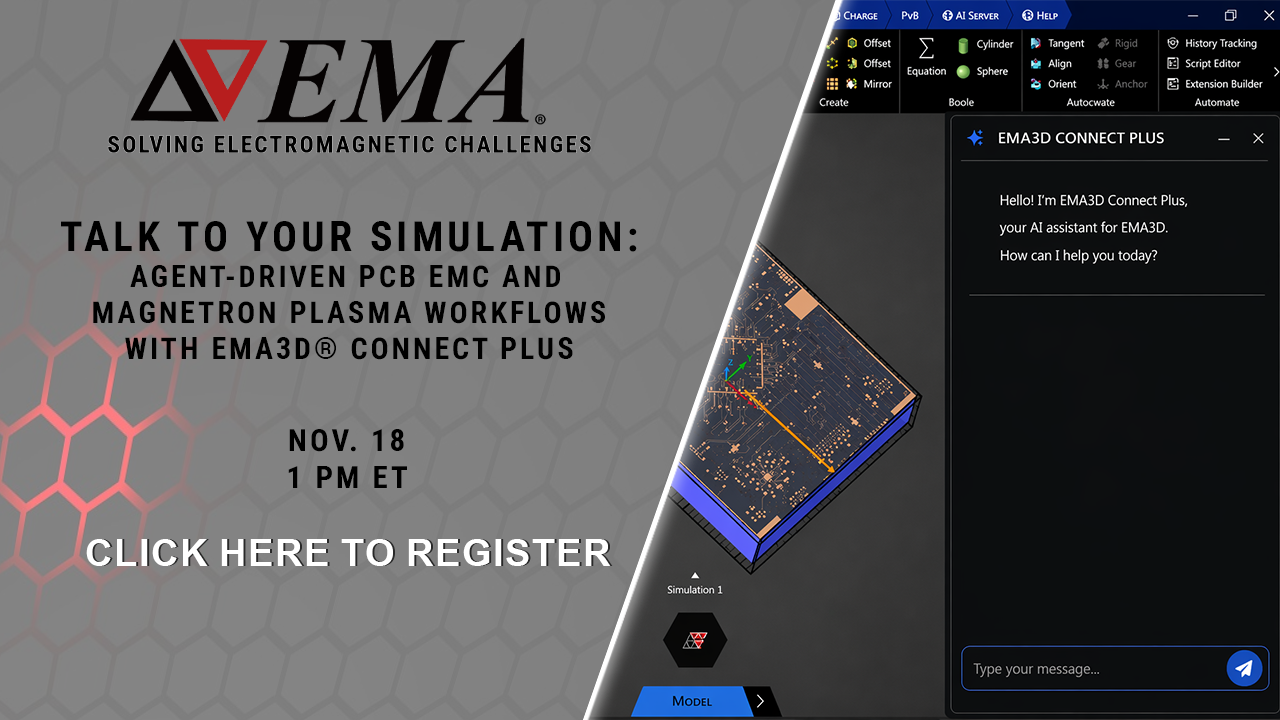
EMA3D Connect Automation Services are designed to address the automation problem. It takes best in class electromagnetic solvers, optimized with NVIDIA-enabled GPU performance, and connects them in a modular architecture, dramatically reducing runtime for large, complex models. EMA is a member of the Nvidia Inception Program.
The modular architecture and agentic coding automation approach lets engineers build workflows faster by integrating existing design and digital engineering tools and automating the creation of simulation models. In practice, engineers can call simulation components through APIs and predefined AI skills, speeding up model setup while reducing the cost and effort of building automations.
“This creates a continuous loop of innovation where we’re able to solve individual engineering problems with simulation,” McDonald explained.
Production Ready Automation with EMA3D Connect
These EMA3D Connect automation technologies are already available in EMA’s software Ansys EMC Plus and Ansys Charge Plus. Current automation workflows include PCB import, source creation from RE102 measurements, and x-ray coupling analysis.
In the reverse propagation workflow, users take a known emitter measured in the real world and reverse propagate it to create a nonproprietary simulation component. This component behaves like the measured hardware and can be inserted directly into a design. All these steps- measurement ingestion, source creation, and model insertion- are fully automated within EMA3D Connect.
Custom Automation Workflows
By working with EMA’s services team, you can develop custom automation workflows tailored to your specific EMC and electromagnetic challenges. These workflows can be created in a fraction of the time and cost required in the past.
EMA’s approach to automation is focused on the future of engineering: fast cycles, earlier insight, and trusted results. By pairing deep electromagnetic expertise with modular, scalable automation, EMA helps organizations move beyond one-off simulations toward continuous, simulation-driven innovation.
“Ultimately, customers get results that they can trust that are grounded in physics and validated through real world testing,” McDonald said.
If your simulations are slowing down your design cycles, it’s time to rethink your workflow.
Contact EMA to discuss your current bottlenecks. EMA will show you exactly where automation can save time, reduce risk, and improve design confidence.