Electro Magnetic Applications, Inc. (EMA) hosts the Solving Electromagnetic Challenges series to explore proven solutions, emerging technologies, and engineering best practices for tackling today's toughest electromagnetic design problems.
Our next webinar is Wednesday, Nov. 18, 2026
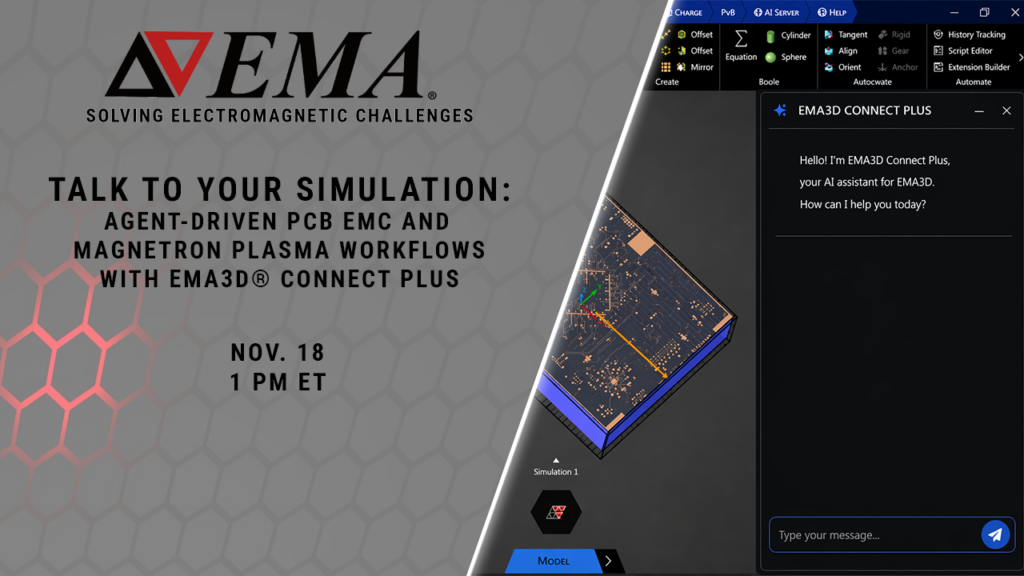
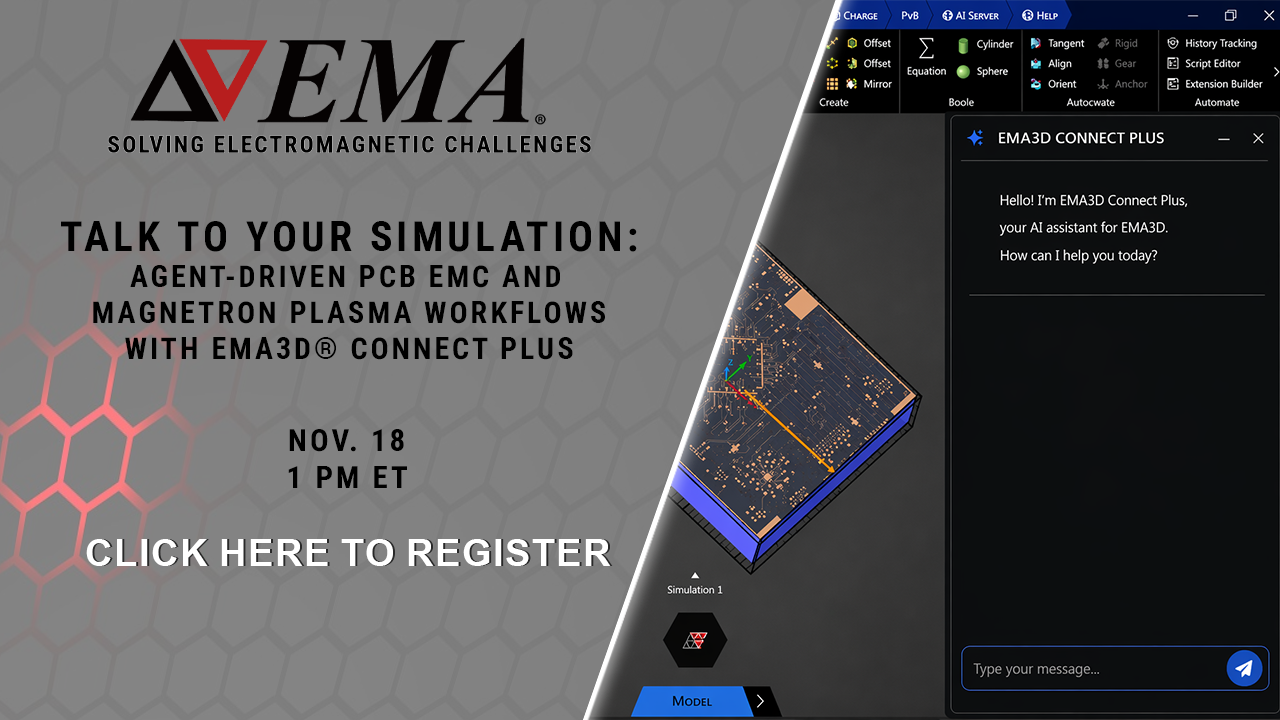
Talk to Your Simulation: Agent-Driven PCB EMC and Magnetron Plasma Workflows with EMA3D Connect Plus
Setting up a simulation takes more engineering time than solving it. A PCB has to be imported, nets selected, meshed, and instrumented with sources and probes. A multiphysics study has to pass fields from one solver to the next without a lost unit or a flipped sign. Each step usually means a different GUI, a folder of files, and results assembled by hand.
EMA3D® Connect Plus exposes every public capability as a callable tool through an MCP server. Engineers bring the agent client and model their organization already approves, then describe the problem in plain language. The agent draws on EMA's engineering methods, which ship as skills, to set the study up the way EMA's own engineers would. It interviews the engineer before it acts and asks for confirmation before it commits an edit. No one clicks a button.
Join us for this webinar, where two EMA engineers show agent-driven setup on two very different problems.
Radiated emissions and susceptibility on a PCB. Watch an agent import a board, mesh it, raise the mesh resolution on request, and hand it to Ansys Discovery for EMC Plus. Then ask which traces are most likely to pick up crosstalk from a USB data pair. The agent reads the board, ranks the candidates by clearance and parallel run length, and places the sources and probes.
Ansys Maxwell to Ansys Charge Plus. See an agent build a magnetron magnet assembly in Maxwell through pyAEDT and run the magnetostatic solve. It then exports the B-field on a grid and uses it as the source for a plasma analysis in Charge Plus.
Learn how EMA methods are packaged as agent skills, including the failure signatures that come from real sessions, such as a coercivity sign that silently reverses a magnet or a field export in meters when the model is in millimeters.
Understand how the same problem definition can run on the full solver or on EMA's Physics AI surrogate, which returns shielding effectiveness up to 628x faster than the GPU solver.
Explore what you need to bring to try this yourself: your own agent client, your own approved model, and no customer data leaving your environment.
At the end of the webinar, attendees will have a clear picture of how agentic setup shortens the path from a design question to a trustworthy EMC or plasma result, and of how to start using it on their own problems.
Gregory Wilson is a Senior Scientist at Electro Magnetic Applications, Inc. (EMA) where he specializes in space environment interactions with materials and spacecraft as well as electromagnetic effects of lightning and other high voltage phenomena. He has worked on numerous projects contracted by NASA, SpaceX, AFRL, and other space focused organizations.
Gregory received his Masters in Physics at Montana State University and his PhD at Utah State University with a focus on energetic electron interactions with Multilayer materials.
Gregory has published dozens of articles focusing on electron ranges in materials, secondary electron yield, surface voltage measurements, and other space based material characterization topics. He has recently worked on high fidelity electromagnetic simulations to understand the coupled interactions of surface and internal spacecraft charging. He is currently participating in the design and construction of EMA’s SERE facility as well as the development of Ansys Charge Plus (formerly EMA3D® Charge).
Patrick Campbell
EMA Scientist II
Patrick Campbell is a Scientist II at EMA. He attended Colorado School of Mines earning a B.S. in engineering physics and a non-thesis M.S. in data science.
Topic: Revolutionizing Radiation Hardening using GPU Acceleration in Ansys Charge Plus Presenter: Kevin-Druis Merenda, EMA Principal Scientist I and Lead Product Manager Zach Stevens, EMA Scientist III Abstract: Designing a spacecraft requires detailed analysis of effects from high-energy space radiation environments. High-energy particles can penetrate deep within electronics, causing electronic noise, degradation, malfunction, and failure. […]
Topic: Lightning Certification, Reimagined: Simulation, Test, and Automation Under One Roof Presenter: Tim McDonald, EMA Co-CEO Abstract: Lightning certification has traditionally meant waiting until late in a program to find out whether an airframe meets its requirements. EMA is changing that timeline. Our portable lightning test capability travels to your facility, injecting the key waveforms […]
Topic: Agentic Engineering with EMA3D Connect: Automated Workflows for EMC Plus and Charge Plus Presenter: Mckenna Partridge, EMA Scientist II Tim McDonald, EMA Co-CEO Abstract: Simulation setup, data processing, and visualization doesn’t have to be manual. This session introduces EMA3D Connect, EMA’s platform for automated simulation workflows, and shows three ways to put it to […]
Topic: New Physics-Based Space Environment Simulation and SEY Measurement for Accurate Charging Risk Assessment Presenters: Kevin-Druis Merenda, EMA Principal Scientist I Justin Christensen, EMA Staff Scientist Abstract: Electro Magnetic Applications, Inc. (EMA) continues to distinguish itself through ongoing advancements in Ansys Charge Plus and the Space Environment and Radiation Effects (SERE) Lab, delivering a uniquely […]
Topic: Modern HEMP/EMP Survivability Challenges and Approaches Presenter: Justin McKennon, EMA Chief Technology Officer Abstract: Today’s systems are becoming more and more distributed/complex. Traditional “measurement only” approaches are introducing more risk to cost and schedule. These activities can only occur after design and build has occurred late in programs. Many measurement campaigns are logistically challenging […]
Topic: Accelerate Biomedical Compliance with EMI/EMC/ESD Simulation Presenter: John Twerdok, EMA VP of Business Development Abstract: For manufacturers of biomedical electronics, achieving EMI, EMC, and ESD compliance is rarely a straight path—it is an expensive, slow cycle of lab testing, failure analysis, redesign, and re‑test. As devices become more compact and the healthcare environment increasingly […]
Topic: Ansys EMC Plus and Ansys Charge Plus 26R1: What’s New Presenter: Kevin-Druis Merenda, EMA Lead Product Manager Abstract: Exciting new capabilities have been added to Ansys EMC Plus and Ansys Charge Plus for 2026R1. EMC Plus highlight features include new: PCB import and meshing capability RE102 auto workflow Cable preparation tool MHARNESS and variable […]
Topic: Accelerating 3D Layout-Based PCB Analysis Using Charge Plus and EMC Plus Presenter: Tim McDonald, EMA Co-CEO Abstract: Modern electronic systems demand fast, accurate electromagnetic modeling that reflects real PCB layouts and component interactions. In this webinar, we’ll introduce powerful new EMA3D Connect capabilities included in EMC Plus and Charge Plus that dramatically streamline full-device […]
Topic: Dangers of Co-located Railroads and Power Lines: Booming Tech Hub Growth, Rising Railroad Risks Presenter: Casey Peirano, EMA Senior Scientist Abstract: The rapid growth of data centers and high-tech factories has made electromagnetic risks from co-located power lines and railroads increasingly common and concerning for rail signaling, personnel, and the public. Data centers and […]
Topic: Production-Grade, Full-Vehicle Electromagnetic Simulation Services Presenter: Tim McDonald, EMA Co-CEO Abstract: Modern vehicles, whether aircraft, automobiles, industrial systems, or oil and gas platforms, are more electrically complex than ever. Ensuring safe, reliable performance across all electromagnetic environments requires a level of modeling fidelity that most organizations cannot build in-house. EMA’s Services Team offers a […]
Newsletter
Follow EMA and learn about webinars and events
We use cookies to ensure that we give you the best experience on our website. If you continue to use this site we will assume that you are happy with it.Ok