Webinars

Electro Magnetic Applications, Inc. (EMA) hosts the Solving Electromagnetic Challenges series to explore proven solutions, emerging technologies, and engineering best practices for tackling today's toughest electromagnetic design problems.
Our next webinar is Wednesday, Oct. 21, 2026
Revolutionizing Radiation Hardening using GPU Acceleration in Ansys Charge Plus
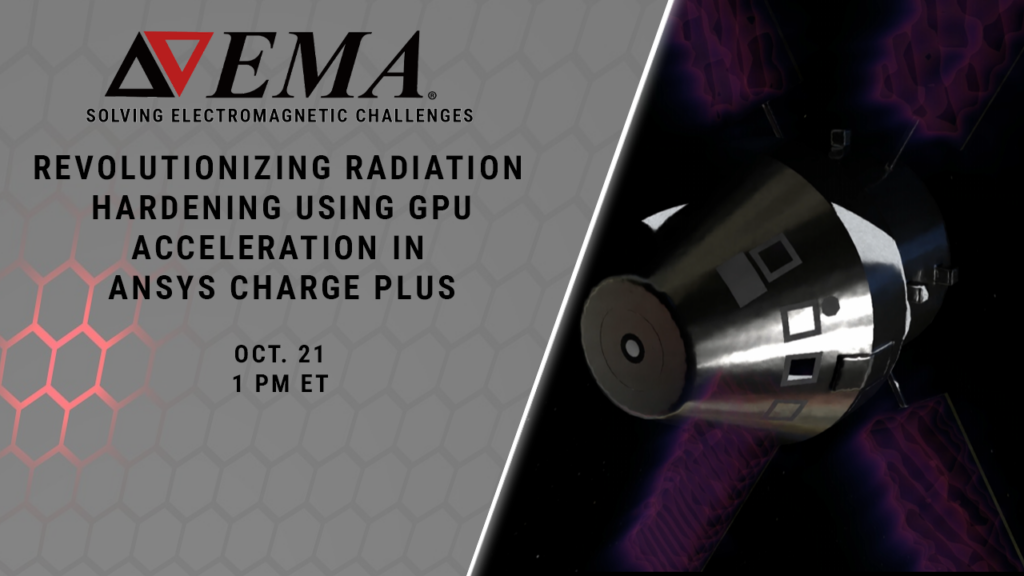
Designing a spacecraft requires detailed analysis of effects from high-energy space radiation environments. High-energy particles can penetrate deep within electronics, causing electronic noise, degradation, malfunction, and failure. Understanding and accounting for these effects is critical to mitigating risk before a spacecraft ever enters orbit. Before 2026 R1, Ansys Charge Plus users already had access to our GPU-accelerated raytracing method and to our forward Monte-Carlo (MC) particle transport on CPU, which typically required access to high-performance computing for complex designs.
Electro Magnetic Applications, Inc. (EMA) is revolutionizing its approach to radiation hardening through GPU-accelerated forward MC particle transport in Charge Plus using NVIDIA’s RTX capabilities. This new solution enables simulation speedups on the order of thousands of times faster than on CPU. While other approaches such as reverse MC are available in the industry, the speedup of the GPU acceleration by EMA is transforming the solution for forward MC simulations. This acceleration gives users the capability to model full systems, such as PCBs within full satellite bodies. With the new flux tally method for secondary particles, multi-scale highly complex designs can be considered in your analysis workflow, changing the landscape of radiation hardening.
As of 2026 R1, the MC GPU Charge Transport solution models the explicit physics of photons and electrons in the simulation, providing detailed statistical reports on quantities such as dose, linear energy transfer, track length, and charge deposition. We retained the same physics kernels as our CPU-based code. This speedup in simulation time allows designers to retrieve detailed results using explicit physics modeling with accelerated turnaround time on a desktop workstation, enabling rapid design modifications to protect against dangerous ionizing radiation. Proton transport is expected for 2027 R1, and integration with the TD-FEM for electrodynamics will follow soon after. This GPU acceleration of the MC particle transport is one-of-a-kind and has not been accomplished before in the industry.
This webinar will explore the background of the GPU accelerated workflow, then delve into a live demo of the capabilities, showcasing the game-changing speedup of the workflow in real time.
Join us Oct. 21 at 1 p.m. ET.
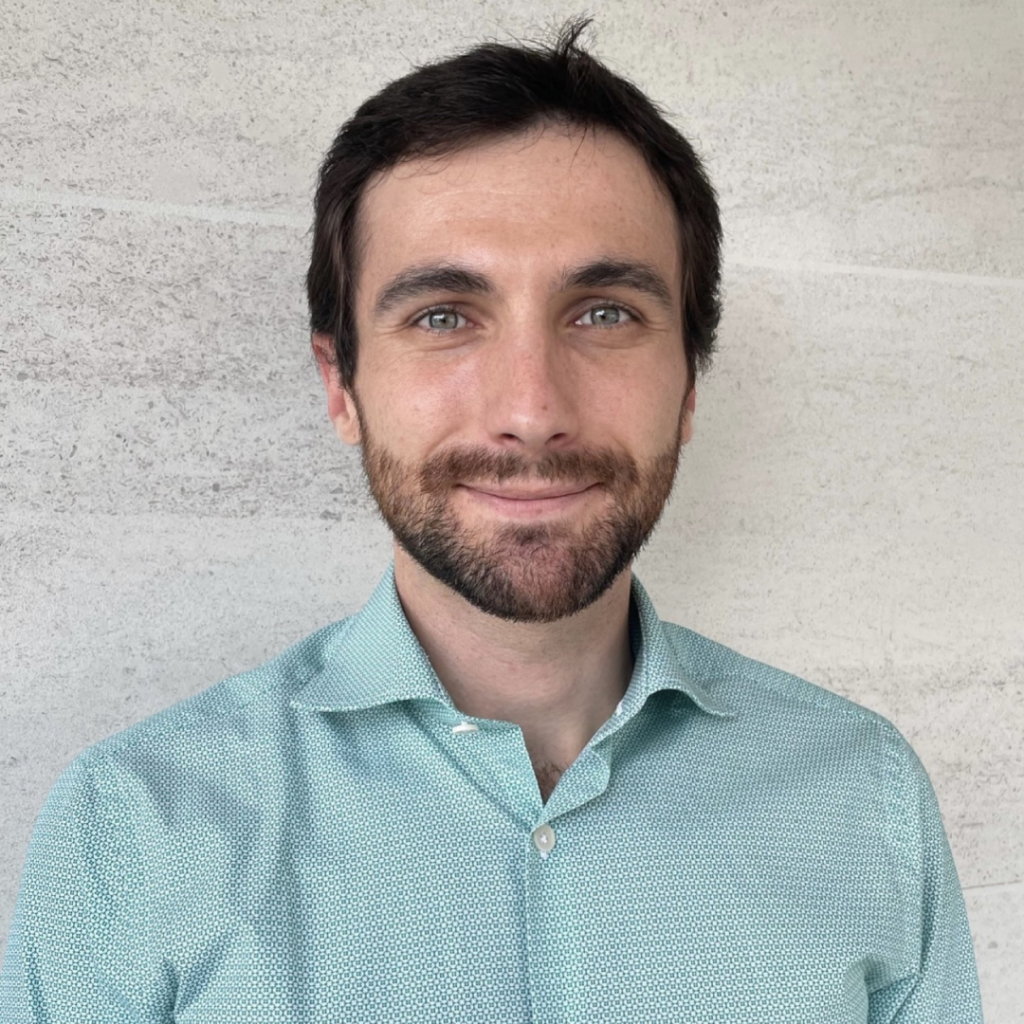
Speaker: Kevin-Druis Merenda
EMA Principal Scientist I
Kevin-Druis Merenda is a principal scientist at EMA and the lead product manager of Ansys EMC Plus and Ansys Charge Plus. Kevin’s expertise is in atmospheric electricity physics, elementary particle physics and computational physics. Through webinars or at conferences, Kevin gives regular updates on the development progress of the two software solutions. He is very excited to discuss this update on the latest big development to the EMA physics solvers.
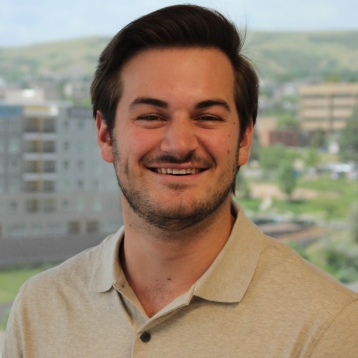
Zach Stevens
EMA Scientist III
Zach Stevens is a Scientist III at EMA who works within the Ansys Charge Plus tool to mitigate risk from threatening space environments. Zach supports numerous projects, including lunar missions where he analyzes risk of system failure due to surface charging and internal charging effects on satellite designs from the radiation environments along mission trajectories. He supports development of the Charge Plus tool through the application engineering teams, testing models to ensure accurate solutions and supporting customers that are using the tool. Zach also supports development of the Ansys STK Shield Plus tool and the workflows embedded within to enable mission engineers to predict electromagnetic effects from lightning, electromagnetic environments, and space radiation environments. Zach graduated from the University of Virginia in 2024 with a Bachelor of Science in Astrophysics, where he researched early-stage black holes and galaxy clusters.