Electromagnetic Engineering and Testing Services to Deliver Certification Ready System Performance

Modern engineering requires predictive accuracy across system-level electromagnetic interactions. Designers need confidence that a design will perform in the real world, under regulatory constraints, environmental stress, and system-level complexity.
Electro Magnetic Applications, Inc. (EMA) provides applied electromagnetics engineering services that combine high-fidelity simulation, controlled measurement, and subject-matter expertise to support the design, validation, and certification of complex systems operating in challenging electromagnetic environments.
By integrating high-fidelity simulation, real-world testing, and expert consulting, EMA enables you to predict performance earlier, reduce risk, accelerate time to certification, and make better informed design decisions earlier in the development process.
EMA’s specialized engineering domains include:
- EMC in electronics and vehicles
- EMI/EMC/E3 effects
- Lightning, HIRF, and EMP environments
- Plasma physics and charging phenomena
- RF systems and antenna interactions
- Semiconductor plasma processing
- Space environments and radiation
EMA supports engineering teams across industries where electromagnetic effects directly impact system performance, safety, and certification outcomes, including aerospace, automotive, high-tech electronics, and energy systems.
End-to-End Electromagnetic Engineering Support

When electromagnetic challenges exceed internal bandwidth or expertise, EMA provides physics-based consulting grounded in decades of applied electromagnetics experience. Our team of scientists and engineers partner directly with your program to accelerate design decisions, reduce risk, and support certification from concept through validation.
Unlike standalone analysis providers, EMA integrates high-fidelity simulation, physical testing, and engineering expertise to deliver results that are not only predictive, but validated and actionable.
EMA supports programs from early designs through final certification, including;
- Requirements definition and tailoring
- Design studies
- Test planning, execution, and correlation
- Documentation and regulatory support
Core services include:
- Full-spectrum E3 consulting across platforms and environments
- EMI/EMC analysis, compliance support, and mitigation strategies
- RF interference and cosite compatibility analysis
- Lightning indirect/ direct effects analysis
- HIRF assessment
- EMP/HEMP survivability
- Electrostatic discharge (ESD) and charging analysis
- PCB design review
- Plasma interaction and arcing risk assessment
- Radiation effects and shielding analysis
- Radiation hardening and survivability design
- Semiconductor plasma processes simulation
- Space environment effects (charging, degradation, plasma coupling)
- Spacecraft charging and plasma environment modeling
Need support beyond these capabilities? Contact EMA to explore a tailored solution.
High-Fidelity Electromagnetic Testing
EMA operates advanced electromagnetic test capabilities to replicate realistic operational environments and certification-level stressors, enabling rigorous validation of system performance under relevant conditions.
EMA’s testing services span a wide range of electromagnetic environments, platforms, and industries, supporting applications from component-level validation to full-system qualification.
Electromagnetic Environmental Effects (E3) Testing

EMA supports full-spectrum E3 validation across severe environments. Consultants have decades of experience and have supported countless lightning and HIRF evaluations on aircraft large and small.
- EMI/EMC Testing and Validation: Radiated emissions and susceptibility testing, conducted emissions and susceptibility, on-board and off-board EMC analysis support. Learn more about our EMI/EMC testing services here.
- RF Interference and Performance Testing: RF interference characterization, spurious emissions measurement, antenna-to-antenna coupling, RF system performance validation
- Lightning and High-Intensity Radiated Fields (HIRF): Direct and indirect lightning effects, aircraft-level lightning transient characterization (ETDL/ATL validation), HIRF survivability testing and analysis, coupling effects on cables and systems
EMA operates in-house HIRF and lightning test systems, enabling accelerated testing compared to traditional outsourced approaches. Measurement capabilities include:
- Component A generator (up to 3kA) and Component H generator (up to 200A) for current and voltage measurements on pins, cable bundles, and structural components, providing the necessary inputs for qualification and certification activities
- Open circuit voltage and short circuit current measurements for pin test definitions
- Cable bundle measurements for multiple burst and multiple stroke environments
- HIRF and TPED testing to quantify the internal electromagnetic environment to establish the certification/qualification levels needed for equipment and systems
- Laboratory testing for low level arc threshold and qualification campaigns
EMA supports aircraft FAA AC 20-136, FAA AC 25.954.1, DO-160, and MIL-STD test campaigns including 461 and 464. The guidance for aircraft characterization tests can be found in the SAE AE-2 documents (ARP5416, ARP5415, ARP6205).
EMA has an on-staff FAA Designated Engineering Representative (DER), certified in lightning, HIRF, and EMI/EMC with extensive aircraft certification experience supporting both FAA and military programs, who can assist with any aspect of your project. Read more about EMA’s work with BETA Technologies here.
Space Environment and Radiation Effects (SERE) Lab
EMA operates the Space Environment and Radiation Effects (SERE) Lab in Pittsfield, Mass. for testing hardware under realistic space conditions.
The SERE Lab can test:
- Plasma and Space Environment Testing: Low earth orbit plasma characterization, spacecraft charging and discharging, surface and internal charging
- Radiation Exposure Testing: Electron radiation testing (up to 100 keV), proton radiation testing (1-150 keV range), and radiation-induced material degradation studies
- UV and Environmental Aging: Accelerating UV aging (AM0 spectrum and tailored spectra), long-duration equivalent exposure (multi-year aging simulation), material degradation and embrittlement testing
- ESD and Charging Tests: ESD testing and analysis, arc detection and characterization, triboelectric charging studies, surface voltage measurements
- Material and Component Characterization: Secondary electron yield and photoelectron yield, charge voltage characteristics, transmission and reflection measurements
- Radiation sources include:
- Electron flood source producing energies between 500 eV- 100 keV with fluxes measurable down to 5pA/cm2 and a max output of 5nA/cm² with beam uniformity staying within 80% of max with a 13”x13” square
- Low plasma generator with an incorporated magnetic filter that produces 5-20eV along with sub-eV electron to mimic the low earth orbit plasma environment that can be used with various gases and output currents to produce densities that range from 1×10¹³ – 1×10⁸ #/m3
- VUV Krypton arc lamp with a continuous spectrum from 125-165nm and an additional peak at 116nm that can be used for surface neutralization and lower end solar simulation
With dynamic shuttering and control capabilities, SERE is completely customizable and can evaluate complex orbit, eclipse conditions, and accelerated lifestyles.
Learn about how the SERE Lab is supporting NASA’s Artemis mission here.
Closed-Loop Test and Simulation
Rather than producing isolated pass/fail outcomes, EMA’s testing generates high-fidelity measurement data that is systematically integrated into simulation workflows to improve model accuracy and predictive confidence.
This establishes a closed-loop validation methodology:
- Early-stage simulation to evaluate design concepts and identify potential electromagnetic risks
- Physical testing of components, subsystems, or full platforms under controlled electromagnetic environments
- Data-driven model calibration using measured responses to refine simulation fidelity
- Improved predictive capability for downstream design iterations and certification analysis
This tight coupling of simulation and test is a core differentiator of EMA’s approach, enabling validated, physics-based engineering insights that support efficient certification and reduce late-stage redesign risk.
Integrated Data and Simulation Interface
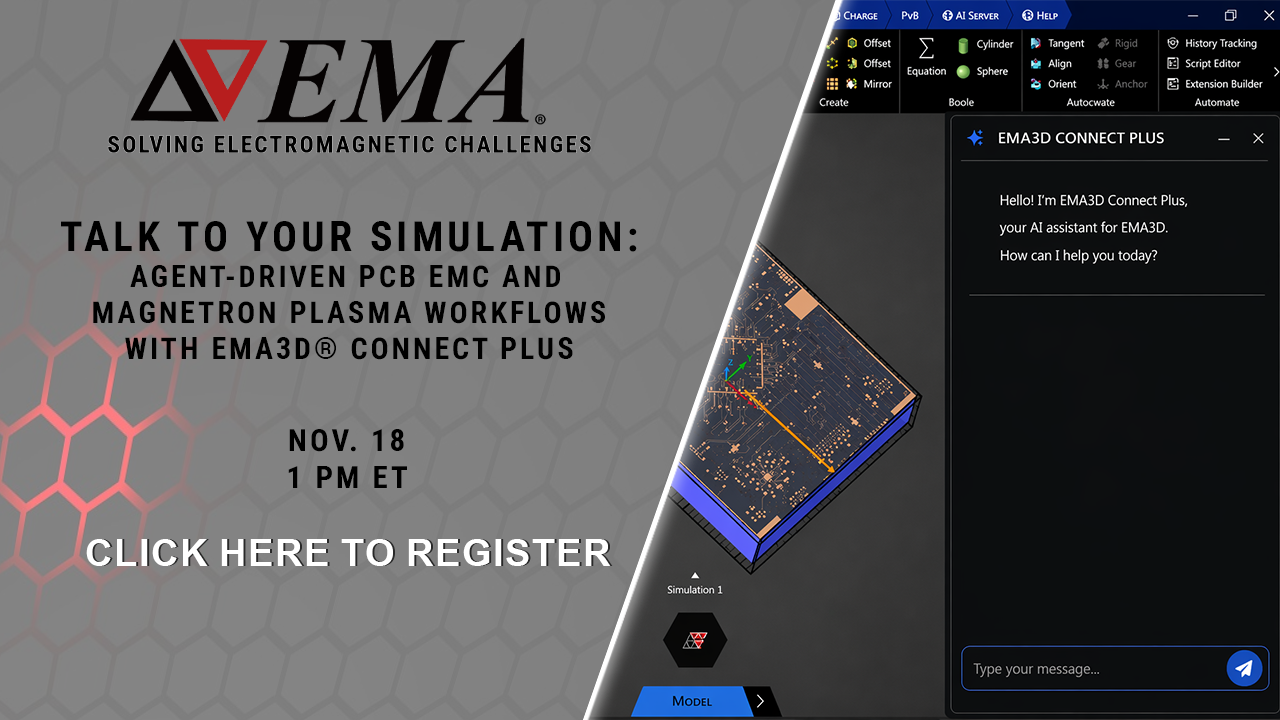
Integration with measured test data is a core capability of EMA3D Connect. The user interface enables direct incorporation of experimental results into simulation workflows.
Within a unified workspace, you can ingest, organize, and correlate test data with simulation outputs to support model calibration and validation. This tight coupling allows users to refine simulation inputs, assess agreement with measured responses, and improve predictive accuracy across design iterations.
Beyond data integration, the Connect UI provides a centralized environment for model setup, workflow automation, and results visualization, eliminating the need to transition between disconnected tools. You can configure simulations, build automated workflows, and interact with solver outputs in real time, while leveraging APIs and scripting to scale analyses across complex systems and large datasets.
By consolidating simulation, testing, and data processing into a single interface, Connect enables traceable, data-driven engineering workflows, improving consistency, accelerating iteration cycles, and supporting validated, physics-based design decisions.
Engineering Confidence from Design to Certification
As electromagnetic complexity and certification demands increase, predictive, physics-based engineering is essential from the start. EMA integrates simulation, real-world testing, and expert consulting into a closed-loop approach that delivers validated, actionable results.
The outcome: reduced risk, faster certification, and greater confidence that systems will perform in real-world environments.
Partner with EMA to bring validated, certification-ready performance to your most critical designs.