Webinars

Solving Electromagnetic Challenges: An EMA Webinar Series

Take part in EMA’s Solving Electromagnetic Challenges webinar series, where you will learn how to overcome the most pressing issues in the industry. Whether it's adapting to new standards, adopting new technologies and methodologies, or optimizing your designs and workflows, Solving Electromagnetic Challenges will give you the edge you need to succeed.


Our next webinar is Wednesday, July 22, 2026

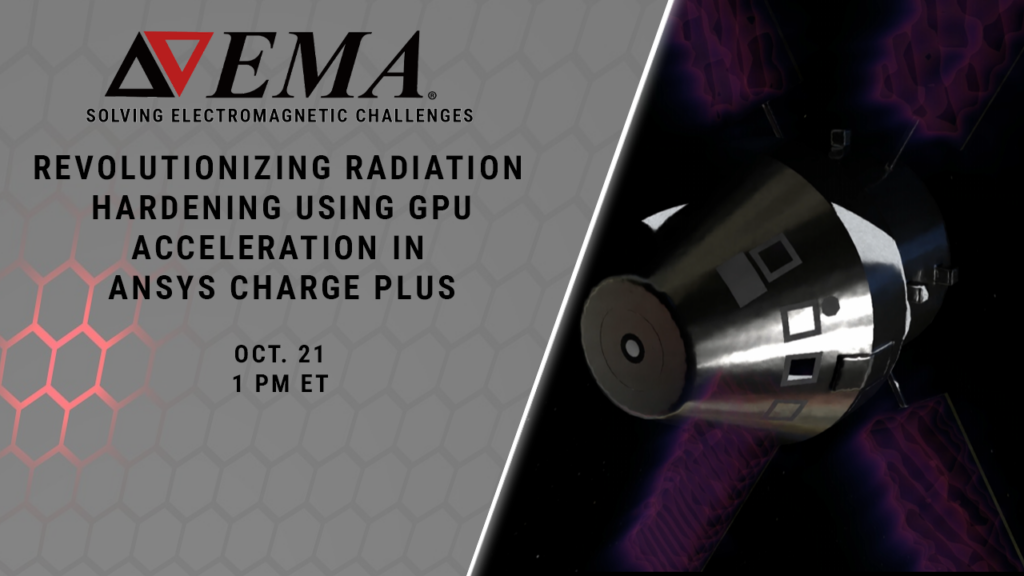
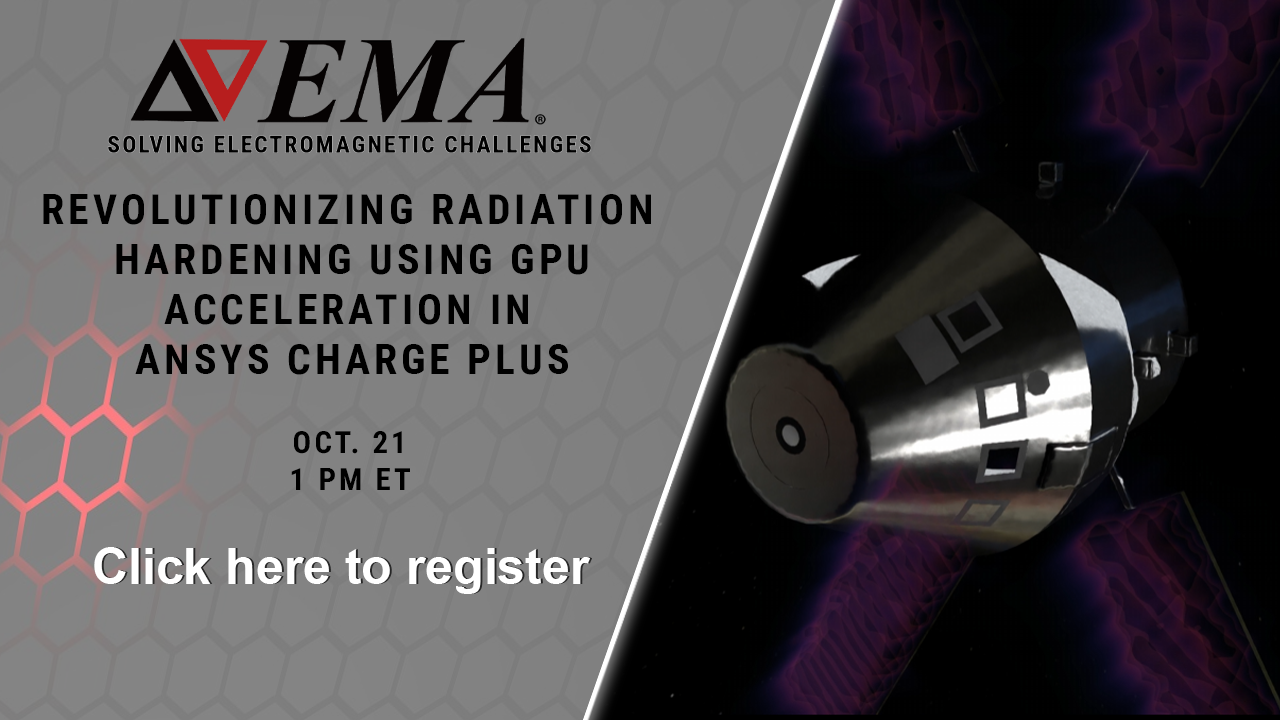
New Physics-Based Space Environment Simulation and SEY Measurement for Accurate Charging Risk Assessment

Electro Magnetic Applications, Inc. (EMA) continues to distinguish itself through ongoing advancements in Ansys Charge Plus and the Space Environment and Radiation Effects (SERE) Lab, delivering a uniquely integrated set of capabilities that are not available through any other provider.

The SERE Lab provides a controlled test environment that recreates realistic space conditions enabling direct measurement of spacecraft charging, electrostatic discharge (ESD), radiation effects, and material behavior under mission-relevant scenarios. At the same time, Charge Plus delivers a physics-based, 3D simulation capability for modeling surface and internal charging, particle transport, and arcing across complex systems. By tightly coupling these capabilities, EMA creates a closed-loop workflow where measured data from the SERE Lab informs and validates simulation models, and simulations guide targeted testing. This combined approach moves beyond standalone software or isolated testing, providing customers with higher-fidelity predictions, reduced risk, and engineering confidence grounded in both physics and proof. 

In this upcoming live session, we will introduce new advancements in space environment simulation and secondary electron yield measurement.

Advancement #1: Space Environment Simulations in Ansys Charge Plus

Through partnerships with NVIDIA and Synopsys, EMA has GPU‑accelerated Charge Plus and integrated it with electronic design automation (EDA) tools, enabling mission‑to‑silicon workflows for radiation hardening and EMC in space and defense.

This integration with Synopsys tools like TCAD Sentaurus Design, allows end‑to‑end modeling from spacecraft and electronics down to silicon, capturing total ionizing dose (TID), linear energy transfer (LET), and device‑level response to high‑energy Galactic Cosmic Rays (GCRs), while accelerating design iteration and decision‑making.

In part one, see how to model radiation effects from orbit to silicon in a single workflow. We will demonstrate the mission‑to‑silicon workflow through an end‑to‑end analysis of GEO electrons interacting with the satellite, electronics, and PCB, culminating in silicon‑level ionizing dose and device response.

Advancement #2: New Secondary Electron Yield Measurement Capability

Secondary electron yield (SEY) is a key material property in spacecraft charging, determining how energetic electron impacts influence whether a surface charges positively or negatively. Inaccurate SEY data directly compromises charging predictions, increasing risk in harsh radiation environments, especially for new materials lacking well‑characterized properties.

EMA’s SERE Lab has established dedicated SEY measurement for spacecraft charging, making EMA one of the few organizations with both insulator SEY testing and integrated simulation capabilities. Using a pulsed, low‑current electron beam and custom instrumentation, EMA characterizes insulating flight materials across relevant energy ranges (50–5000 eV) while preserving surface state for accurate results. This measured data feeds directly into simulation workflows, enabling more reliable, material‑specific charging risk assessments.

Attendees will walk away with:

  • A clear understanding of mission-to-silicon workflows for modeling radiation effects using Ansys Charge Plus
  • Insight into how GPU acceleration and EDA integration are improving simulation speed and design iteration
  • Knowledge of secondary electron yield (SEY) measurement techniques and their impact on charging accuracy
  • A practical view of closed-loop validation, combining simulation with SERE Lab measurement data

Don’t miss this opportunity to see how physics-based simulation and validated testing can transform your approach to space system design.

Join us on July 22 at 1 p.m. ET.

Speaker: Kevin-Druis Merenda

EMA Principal Scientist I

Kevin-Druis Merenda is a principal scientist at EMA and the lead product manager of Ansys EMC Plus and Ansys Charge Plus. Kevin’s expertise is in atmospheric electricity physics, elementary particle physics and computational physics. Through webinars or at conferences, Kevin gives regular updates on the development progress of the two software solutions. He is very excited to discuss this update on the latest big development to the EMA physics solvers.

Speaker: Justin Christensen

EMA Staff Scientist

Justin Christensen is a Staff Scientist at Electro Magnetic Applications, Inc (EMA) working in the Space Environment and Radiation Effects (SERE) testing laboratory. His work focuses on measuring and modeling spacecraft charging behavior, with specialization in secondary electron yield (SEY) measurement, low-current detection, and charging dynamics of spacecraft materials. Before joining EMA in 2024, Justin spent six years at Sandia National Laboratories as a technologist in a team of atomic physics researchers, where he contributed to experimental design, fabrication, testing, and data analysis. While there, he gained experience building sensors, designing circuit boards, performing low-frequency electrometry, and collaborating with multidisciplinary teams of researchers. A significant project involved translating optical-table-scale experiments into compact, transportable sensor systems. Justin holds a master’s degree in physics from Utah State University, where he studied spacecraft charging and performed SEY measurements on high-yield, low-conductivity dielectrics, as well as characterized optical emissions from materials exposed to space-like electron fluxes.


View our previous webinars here:

FDTD sub grid modeling

2021 R2 Ansys EMC Plus: Faster EMC Solving for Electronic Devices and Entire Vehicles

Topic: 2021 R2 Ansys EMC Plus: Faster EMC Solving for Electronic Devices and Entire Vehicles Presenter: Tim McDonald, EMA President Abstract: This webinar showcases how the new features in EMA3D® Cable (now Ansys EMC Plus) help you tackle Electromagnetic Interference (EMI) challenges including radiated emissions, radiated immunity, electrostatic discharge (ESD), and interference between systems integrated on […]

Cell phone simulation

Ansys EMC Plus 2021 R2: Electronics and Consumer Electronics

Topic: EMA3D® Cable (now Ansys EMC Plus) 2021 R2 What’s New: Electronics and Consumer Electronics Presenter: Tim McDonald, EMA President Abstract: EMA3D® Cable (now Ansys EMC Plus) is a robust electromagnetic compatibility (EMC) cable modeling solution for small electronic devices up to large complex platforms. EMA3D® Cable has recently been updated to include new features to accurately […]

Automotive EMC analysis

Simulation and Modeling Approaches Useful for Automotive EMC Analysis

Topic: Simulation and Modeling Approaches Useful for Automotive EMC Analysis Presenter: Karen Burnham, EMA Principal Scientist I Abstract: Failing automotive EMC requirements in the test lab leads to many extra costs and schedule delays. With the push for more electric vehicles (EVs), the electromagnetic environment in a car is getting harsher. With the advent of […]

HIRF Certification

Guide to Using Simulations for HIRF Certification Activities

Topic: Guide to Using Simulations for HIRF Certification Activities Presenter: Cody Weber, EMA Principal Scientist Abstract: Cody Weber reviewed the HIRF guidance documents AC20-158 and ARP5583 to understand which activities are typically performed for HIRF compliance demonstration. The webinar also covered how computational electromagnetic (CEM) simulations with EMA3D® can support HIRF design and compliance activities […]

Vehicle EMC requirements

How to Achieve Automotive EMC Certification Success at the First Pass

Topic: How to Achieve Automotive EMC Certification Success at the First Pass Presenters: Karen Burnham, EMA Principal Scientist I Flavio Calvano, Ansys Lead Application Engineer Abstract: Automotive systems are becoming more complex with each new technical development that is added to them. This increases the Electromagnetic Compatibility (EMC) challenges for the automotive platform. Passing EMC requirements is […]

RF system and cables simulation

Platform-Level Integration of Antennas, RF Systems, and Cables

Topic: Platform-Level Integration of Antennas, RF Systems, and Cables Presenters: Matt Miller, EMA Principal RF Engineer II Fred German, Ansys Director of R&D Abstract: Virtually every modern platform includes RF systems for a variety of functions including navigation, communication, surveillance and sensing. These RF systems are connected to antennas via cables routed through the vehicle […]

HFSS to EMA3D

EMA3D (now Ansys EMC Plus) 2021 R1 What’s New Webinar

Topic: EMA3D 2021 R1 What’s New Webinar Presenter: Tim McDonald, EMA President Abstract: In this webinar, Tim McDonald, PhD, will be going into more detail for the most anticipated updates: HFSS Field Link: ability to use HFSS near fields as source, import of harness description list (KBL) files, and exporting S-parameter models; As well as […]

Civil aircraft simulation

Guide to Civil Aircraft Electromagnetic Compatibility (EMC)

Topic: Guide to Civil Aircraft Electromagnetic Compatibility Presenters: Tim McDonald, EMA President Bill Martin, EMC Expert Abstract: We review the guidance in SAE ARP60493 for demonstrating that electrical and electronic systems installed on civil aircraft can operate without adversely affecting the operation of other aircraft electrical and electronic systems. This includes guidance for defining appropriate […]

Installed antenna performance and RFI

Installed Antenna Performance and RFI

Topic: Installed Antenna Performance and RFI Presenter: Matt Miller, EMA Principal Scientist II Chris Maholm, Dayton Granger Director of Business Development Abstract: Radio Frequency (RF) systems represent one of the most critical technology areas today. Without RF systems, all types of vehicles cannot navigate, communication cannot occur, advanced weapons cannot hit their targets, and the […]

EMC qualification

EMC Qualification Analysis to Electric units

Topic: Analysis to Predict Electromagnetic Compatibility (EMC) Compliance of Units and Devices for Suppliers Presenter: Tim McDonald Abstract: Tier-1 suppliers of electronics units for aircraft, automobiles, or other platforms must meet electromagnetic compatibility (EMC) requirements. Platform integrators establish EMC requirements in order to ensure overall system compatibility. Almost always, the method of compliance to the […]

Newsletter